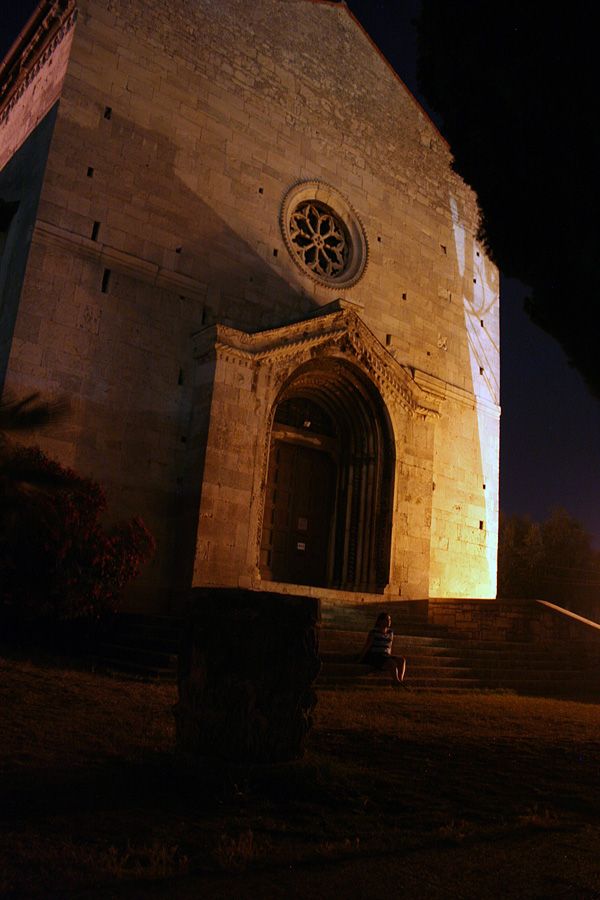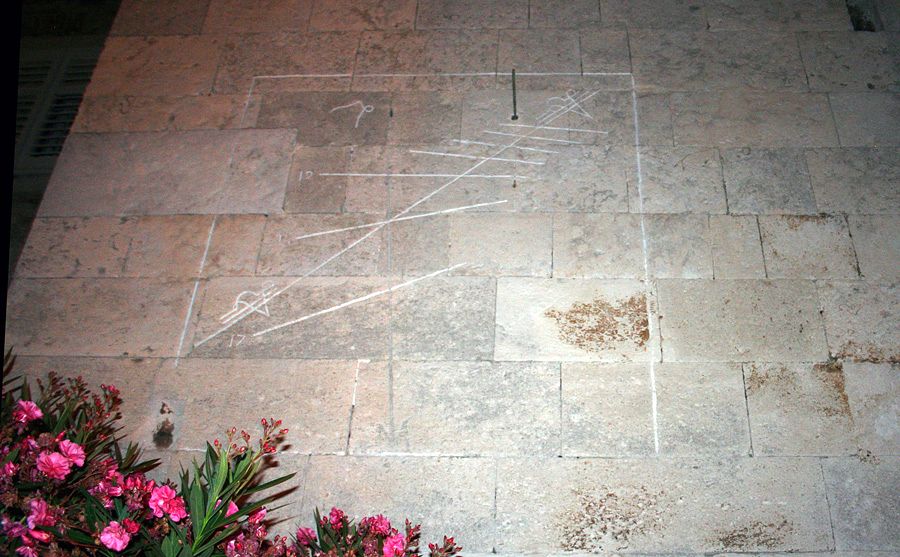
The sundial on the southwest facade of the church and monastery of St. Francis. It is assumed to be the oldest Istrian sundial [Medvedec 1999, 2001], and dates from the 14th century. The monastery itself was probably completed in the late 13th century, and was built on the site of an ancient building and then the early Christian complex of St. John the Baptist [Krizmanić 1998]. The construction is attributed to Fra Jakov Puljanin.
According to the story of the guardian of the monastery, Đuro Vuradin [Medvedec 1999], the engineer Stipe Rubinić from the island of Cres, who recorded and visited sundials in Croatia, helped in deciphering the sundial. Father Vuradin says: The sundial is carved on the facade of the church of St. Francis, which was built at the turn of the 12th and 13th centuries. Time was then calculated according to the Jewish system: sunset meant the beginning of a new day, and night and day were divided into six hours. Since the sun rises and sets, only on March 21 and September 22 does the tip of the shadow move along the red meridian line all day long. The father further states that the red line marks the meridian, and the black lines mark the parallels. The sundial had been in poor condition for a long time, and Father Vuradin restored it with the expert advice of engineer Rubinić[Medvedec 1999].
W. Scotti adds an explanation: "Italian sundials (Italic or Bohemian) were most often created in the areas of Italy, Bohemia, Silesia and Poland. With sunset (the 24th hour), the day would end and a new one would begin. A characteristic of the Italic bell tower sundial is the shift of the 24th hour by an additional 30 minutes after sunset (when the bells rang the Hail Mary). In this way, the end of the day coincides with twilight. The meridian line (the letter M) is visible, which in this case indicates 12.30, while the 24th hour is not marked. The sun is already 30 minutes below the horizon. This change in time measurement is called the Italic bell tower sundial (Italico da campanile)."
References:
- http://www.istrapedia.hr/hrv/1664/suncani-satovi-u-istri/istra-a-z/
- http://www.istrapedia.hr/hrv/759/franjevacki-samostan-i-crkva-sv-franje-u-puli/istra-a-z/
- Medvedec, V. (2001) Sundials in Istria, Franina and Jurina, 2001.
- Krizmanić, A. (1998) Monastery and Church of St. Francis Pula, Pula
- Medvedec, V. (1999) Supetar's Smallest Clock in the World, Glas Istre, August 15, 1999, 18